Tobet Breed Standard
Approved by Order No. 101 of the Ministry of Ecology and Natural Resources of the Republic of Kazakhstan dated 30 March 2023.
Tobet Breed Standard
1. General body structure and sex type
Faults: dry, excessively massive or loose body structure; low-stationed or stocky build; short body proportions; insufficient muscle development; males not conforming to male sex type, with a feminine appearance; underdeveloped testicles.
2. Behaviour / temperament
Standard: strong and enduring.
Faults: shyness; lethargy; excessive excitability.
Disqualifying faults: cowardice; uncontrollable aggression.
3. Head
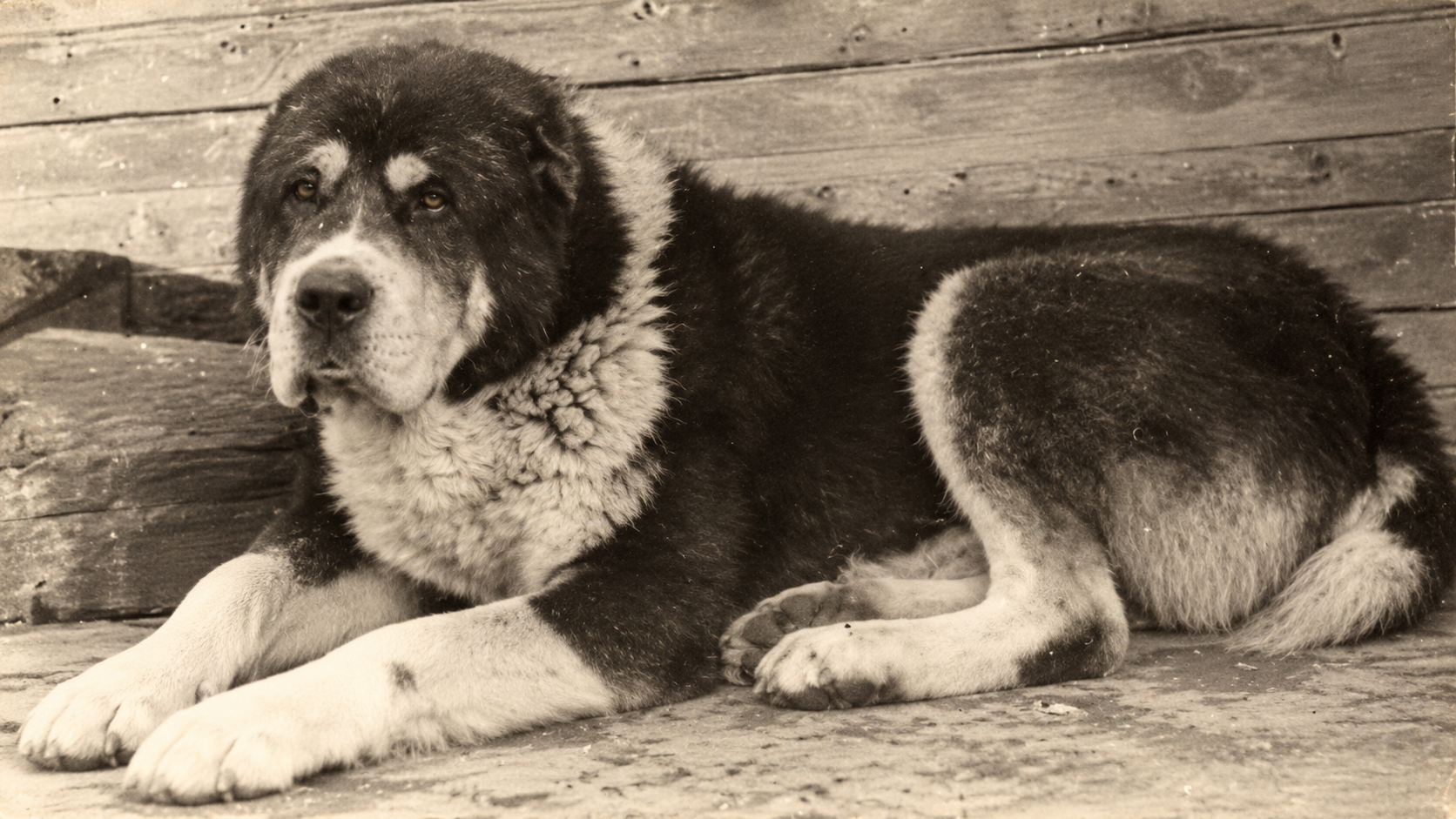
Standard: heavy and massive, with fairly well-developed supraorbital and zygomatic arches, parietal crest and occipital protuberance.
Skull: moderately broad, oval and long. The forehead is flat, with a slight groove in the middle.
Stop: gradual.
Nose: large, black and evenly pigmented, with wide nostrils. Dark brown is permitted in light-coloured dogs. It projects slightly forward beyond the lower jaw.
Muzzle: somewhat shorter than the skull; not filled under the eyes; almost not tapering toward the nose, with a slight Roman nose near the nose leather. The muzzle line is set slightly lower than the forehead line.
Lips: thick. The upper lip has a blunt edge and covers the lower lip. Dark lip edging is preferred.
Faults: a short muzzle — less than 1/3 of the head length — or a long muzzle — more than 1/2 of the head length; excessively pronounced cheekbones; protruding supraorbital arches; parallel muzzle and forehead lines; brown nose in light colours.
Serious faults: a head disproportionate to the overall build — excessively massive, narrow, short or light; strongly convex forehead; domed skull; sharply defined stop; sharply pronounced occipital protuberance; excessively convex cheekbones; unpronounced supraorbital arches; muzzle longer than the forehead; upturned or pointed muzzle; thin, tightly fitting lips.
4. Jaws / teeth
Standard: jaws are broad, strong and well developed, with a clearly defined chin. Scissor bite. A level bite is permitted in dogs over three years of age. Full dentition; teeth are very large, white and closely set. The bases of the incisors are arranged in one line.
Faults: teeth worn beyond what is appropriate for the dog’s age; slight yellow plaque or damaged enamel — up to 1/3 of the tooth surface; bases of the lower incisors not arranged in one line; medium-sized teeth; level bite before three years of age; absence of first premolars in the lower jaw; extra premolars.
Serious faults: small, sparse, yellow teeth with severely damaged enamel — more than 1/3 of the tooth surface; bases of the upper incisors not arranged in one line; level bite before three years of age; absence of one premolar or molar other than the first premolars; extra teeth.
5. Eyes
Standard: small, obliquely set, wide apart and deep-set, dark brown. In light-coloured dogs, eyes matching the coat colour are permitted. The eye shape is almond-shaped. Eyelids are thick, and the third eyelid is pronounced. Dark eyelid edging is preferred. The expression is subdued, stern and heavy.
Faults: dull; light brown eyes.
Serious faults: straight-set eyes; oval or round eye shape; protruding eyes; eyes lighter than the coat; odd-coloured eyes; yellow, green, blue or grey eyes; bulging, light, colourless, yellow, green or grey eyes; restless, roaming expression; depigmented, excessively loose, thick or drooping eyelids.
6. Ears
Standard: small, pendant, triangular, set slightly above eye level. The base of the ear is small. Ears are cropped short in puppyhood.
Faults: ears set at eye level.
Serious faults: low-set; semi-erect; rounded ears.
7. Neck
Standard: equal in length to the head, broad at the base, powerful, set at an angle of 35–45 degrees to the topline, with a characteristic but not excessive dewlap.
Faults: high neck carriage; insufficient muscle development.
Serious faults: neck set too high or too low; absence of a dewlap or an excessively pronounced dewlap.
8. Body
Topline: in a free stance, the dog stands relaxed. The topline has a characteristic slight, smooth dip, with the lowest point at the topline depression and the highest points at the withers and hip bones. In movement or a tense stance, the topline from the withers is straight, resilient and strong. Musculature is powerful; the tips of the vertebral spinous processes are not visible.
Withers: well defined, broad, long — reaching the topline depression — and powerful, especially in males.
Back: strong, broad, well muscled, with only a slightly noticeable topline depression.
Loin: broad, strong, elastic and well filled with powerful musculature. Slightly convex in a natural stance; straight in a tense stance and at the trot.
Croup: long, broad, flat, sloping and muscular.
Chest: oval in cross-section, capacious, moderately broad, long and deep; widening behind the shoulder blades, reaching to the level of the elbows or slightly below; false ribs are long. The forechest is only slightly pronounced.
Belly: moderately tucked up.
Faults: insufficient musculature; weakly defined withers; narrow back; strongly pronounced topline depression; slightly narrow or slightly convex loin; rounded, shortened or strongly sloping croup; insufficiently deep chest — not reaching the elbows by more than 2–3 centimetres; insufficient chest capacity; excessively convex ribs; excessively tucked-up or pendulous belly.
Serious faults: convex, stiff or sagging, soft topline in free stance, tense stance and movement; underdeveloped musculature; unpronounced, low, narrow or short withers; narrow, short, sagging or roached back; absence of the topline depression; narrow, strongly convex loin; narrow, short, strongly sloping or horizontal croup; flat, narrow, shallow, underdeveloped or barrel-shaped chest; strongly shortened false ribs; strongly pronounced forechest; long, sunken or excessively convex loin; sharply tucked-up belly.
9. Tail
Standard: set high and thick. Cropped in puppyhood, usually leaving about 1/3 of its length. When uncropped, it hangs in a sickle shape and reaches the hock joints.
Faults: thin tail.
Serious faults: low-set tail.
10. Forelimbs
Standard: sufficiently long, strong and muscular; straight and parallel when viewed from the front. Height at the elbow is equal to or slightly greater than half the height at the withers.
Shoulders: muscular and strong. The shoulder-blade angle is sufficiently pronounced. Shoulder blades are long and obliquely set.
Elbows: directed strictly backward.
Forearms: straight and strong, round in cross-section. The carpal joint is clearly visible.
Pasterns: broad, strong and set at a slight angle.
Faults: insufficient musculature; narrow, close or wide forelimb placement; insufficient shoulder-blade angle; elbows slightly turned out or in; excessively sloping pasterns; slight east-west feet or toeing-in.
Serious faults: short limbs; curved or deformed limb bones; underdeveloped musculature; upright shoulder blade; elbows strongly turned out or in.
11. Hindlimbs
Standard: strong and muscular. When viewed from behind, straight and parallel, proportionate to the forelimbs. Set slightly wider than the forelimbs. All joint angles are well defined.
Thighs: broad, with well-developed musculature. Femurs are set with a slight slope.
Lower thighs: strong, well muscled and sloping. Tendons are thick and elastic; the point of hock is well defined and rounded.
Stifles and hock joints: well defined and clearly outlined.
Metatarsi: strong and vertical. Feet are large: front feet are round, hind feet are more elongated; arched, with strong, tightly closed toes. Pads are thick, with hard, thick skin.
Faults: insufficiently defined joint angles; wide, close or narrow hindlimb placement; presence of dewclaws if not removed; slightly open or somewhat flat toes.
12. Gait / movement
Standard: economical, free and light. At the trot, the topline is level and strong; the joints of the forelimbs and hindlimbs extend freely, and the back and loin work with elastic spring. Typical gaits are an unhurried walk and a smooth, ground-covering trot, with the feet placed in one track.
Faults: insufficiently free extension of the joints.
13. Skin
Standard: thick, dense and elastic, with well-developed subcutaneous tissue, mobile in relation to the musculature. It forms a characteristic dewlap in the neck area.
Faults: inelastic skin.
14. Coat
Standard: coat is dense, coarse and straight, with a well-developed but not long undercoat — shorter than the guard hair. On the head and front surfaces of the limbs, the coat is short, straight and close-fitting. On the neck, longer guard hair forms a “collar,” especially developed in males; on the backs of the thighs it forms “trousers.” On the throat and in the dewlap area, the coat is especially dense and thick. The coat length is 10–15 centimetres; the hair lies close to the body, with weakly developed, non-prominent furnishings.
Faults: coat not lying close to the body; undercoat equal to or longer than the guard hair; long, dense and soft hair between the toes, extending beyond the toes.
15. Colour
Standard: all colours and shades of natural colour are typical: yellow, fawn, red, grey, brown and black.
Faults: spotted — with coloured patches making up less than 30 percent; white; solid colour.
16. Size
Height at the withers equals height at the croup; head length is at least 40 percent of the height at the withers; body length exceeds height at the withers by approximately 10 percent, with males being somewhat more compact than females. Optimal height for males is 72–75 cm, and for females 65–70 cm.
Disqualifying faults
Cowardice, choleric temperament, uncontrollable viciousness; unilateral or complete cryptorchidism; undershot bite; overshot bite; incomplete dentition — absence of more than two teeth in any combination; heterochromia; brown colour when the nose leather, eyelid rims and lips are brown, or blue colour when the nose leather, eyelid rims and lips are grey, in any combination; curly soft coat; weak joint stability, unbalanced movement; males of feminine type.
Note: Males must have two normally developed testicles fully descended into the scrotum.